MASS TIMBER TIMES | YOUR BEST SOURCE FOR MASS TIMBER NEWS | NOT SUBSCRIBED? CLICK HERE TO SUBSCRIBE
Innovation
This Patented Technology is Upgrading Wood Construction
5 minute read
January 29, 2026
What If We Made Wood Stronger—Not Just the Building Around It?
Mass timber has come a long way in the last decade. Taller buildings. Faster installs. Better carbon stories. More confidence from code officials and insurers.
And yet, for all its momentum, mass timber still runs into a few stubborn constraints.
- It often comes with a cost premium. - It relies heavily on a narrow slice of high-grade fiber. - And spans and grids can limit where it truly competes with steel and concrete.
The industry’s most common response has been hybrid systems: pairing timber with steel or concrete to compensate for those limits. That approach works, and it’s helped get more wood into buildings.
But it’s still a workaround.
So what if we asked a different question?
What if we improved the material itself?
That’s the question that took us to Toronto, inside the headquarters of Nucap Industries, where a quietly developed technology called GripMetal is challenging some long-held assumptions about wood construction.
At its core, GripMetal is thin-gauge sheet metal covered in thousands of microscopic hooks. When pressed into wood, those hooks don’t just grip the surface, instead, they mechanically lock deep into the fiber structure. The result is a mechanical attachment that transfers the strength and ductility of metal directly into wood products, without relying on adhesives or chemistry.
The simplest analogy is rebar for wood.
But what makes this interesting isn’t just the concept, it’s where the technology comes from.
Before GripMetal was ever applied to wood, it had to survive one of the harshest performance environments imaginable: automotive braking systems. The underlying technology, known as NRS (Nucap Retention System), has been used in over a billion brake pads in the field with zero recorded failures. It’s designed to withstand extreme heat, pressure, moisture cycling, and corrosion... conditions that would cause many glued or coated systems to fail.
That safety pedigree matters when you start talking about buildings.
Inside Nucap’s facility, we saw how this mechanical attachment system is already being used in a modular wood product called EZBlocks. These blocks are manufactured by layering wood and GripMetal in a press, creating a fast, repeatable, high-throughput process that’s already been deployed in real-world projects from retail and restaurants to art installations and DIY builds.
EZBlocks prove the concept. But behind the scenes, the work is moving toward something much bigger.
The next frontier is mass timber.
Nucap and its partners are exploring how GripMetal could be integrated directly into CLT, NLT, and glulam assemblies. The goal is performance and efficiency increases. By reinforcing timber with thin metal layers, the team is investigating whether they can:
Increase spans without increasing member size
Improve ductility and failure modes
Reduce the amount of premium lamstock required
Enable the use of lower-grade or underutilized fiber
Testing has been underway in Europe for more than five years at the University of Innsbruck, where GripMetal has been shown to improve joint strength by 200–300% in certain configurations. That research led to a European Technical Assessment in partnership with Rothoblaas, where the product is already being used for timber-to-timber connections under the name Sharp Metal.
Now, that research is advancing in North America.
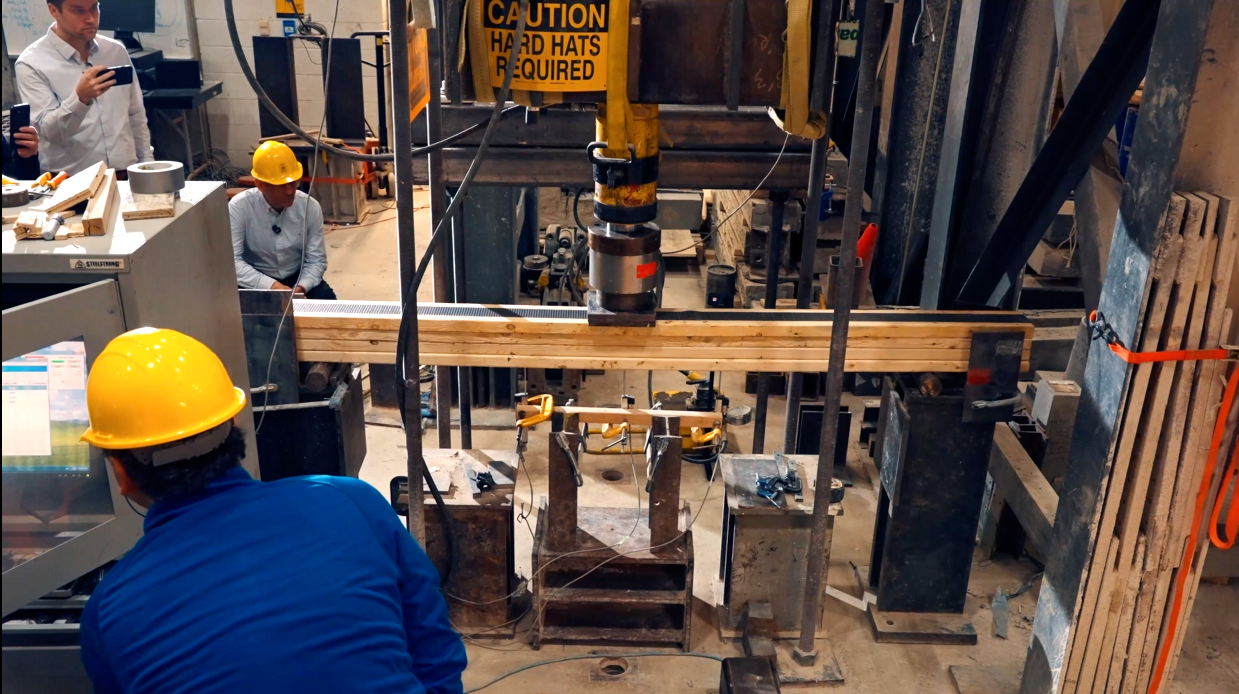
Working alongside Toronto Metropolitan University, WZMH Architects, sparkbird, and Salas O’Brien, the team is testing how reinforced wood assemblies behave under real structural loads. In one hands-on experiment, we helped assemble a small glulam mock-up using mixed lumber grades, including boards that would typically be considered utility or low-grade material.
Timber beams often fail suddenly (brittle) along a crack or finger joint. Early observations from testing suggest that introducing metal reinforcement can change that behavior, creating more gradual, ductile failure modes. For engineers, it’s a fundamental shift in how risk and performance are evaluated.
It’s still early. And no one is claiming this is a finished product or a solved problem.
But that’s precisely why it matters.
We’re already working with glulam producers to test GripMetal inside real, commercial beam products (more on those results to come). The next phase is about scale and variation: different species, different grades, different assemblies, and full-scale testing against industry standards.
If the results continue to hold, the implications are significant.
- Lower costs through better material efficiency. - Broader fiber baskets and regional wood utilization. - Longer spans that open doors to new building types.
Mass timber doesn’t just need better buildings.
It may need better materials.
And sometimes, progress doesn’t come from adding more, it comes from reinforcing what’s already there.
If you haven’t watched the video yet, it’s worth your time.
And if you’re a manufacturer, engineer, or architect interested in pushing material performance forward, this is very much an invite to reach out and test your ideas and products.
Tired of Mass Timber Challenges Derailing Your Projects? Learn How to De-Risk & Deliver Them.
Lead mass timber projects with confidence — and leave delays, redesigns, and budget blowups behind. ✅ Solve early-stage design, sourcing, insurance, permitting, code & cost hurdles before they derail your project.
✅ Find technical answers on design, detailing, procurement, embodied carbon ROI, hybrid systems & more.
✅ Build relationships with developers, GCs, architects, and engineers shaping mass timber’s future.
Get your ticket— and get the insights, skills, and network to deliver mass timber projects successfully.
.avif)
.png)


.png)

.jpg)

.png)